Fly Ghost: Integrating Spooky Illustrative Typography into Your Design Workflow
In the realm of seasonal graphic design, efficiency and thematic consistency are often at odds. Designers, crafters, and small business owners frequently face the challenge of sourcing high-quality, cohesive spooky imagery for Halloween projects without spending hours manipulating individual vector files. This is where Fly Ghost enters the workflow as a strategic asset. Rather than functioning as a traditional typeface for readable text, The Fly Ghost Font operates as a comprehensive dingbats library, mapping an extensive collection of illustrative characters to standard keyboard inputs. This approach transforms the way creators handle thematic decoration, shifting the process from manual asset hunting to rapid typographic composition.
Understanding the Asset Structure
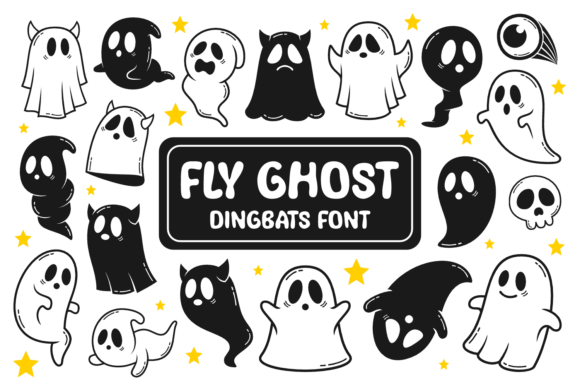
To effectively integrate this tool into your creative pipeline, it is essential to understand its unique architecture. Unlike standard fonts that prioritize legibility, this font is entirely illustrative. It does not produce alphabetical letters in the conventional sense. Instead, it offers two full sets of ghostly figures mapped to uppercase and lowercase keys. This dual-layer structure provides immediate variety, allowing users to access different poses, expressions, and design nuances simply by toggling the shift key.
Beyond the core ghost characters, the font includes a supplementary set of icon characters. These elements feature skulls, eyeballs, bones, and bats, which serve as critical decorative accents. By consolidating these diverse assets into a single installable file, the font reduces file management overhead. You no longer need to organize folders of separate PNGs or SVGs for each element; everything is accessible through your existing typography tools.
Pre-Production Planning and Compatibility
Successful implementation begins with verifying compatibility across your software ecosystem. Because this font relies on standard character mapping, it integrates seamlessly with major design platforms such as Adobe Illustrator, Photoshop, InDesign, and affinity Designer. For those working in digital cutting environments, such as Cricut Design Space or Silhouette Studio, the font’s structure is particularly advantageous.
Before starting a project, assess whether your output method requires solid fills or outlines. The clean, solid design styles of the characters translate exceptionally well to vinyl cutting and sublimation. However, if your workflow involves laser engraving or specific print-on-demand requirements, you may need to convert the text to outlines early in the process. This ensures that the illustrative integrity remains intact regardless of the production machine’s interpretation of font data. Preparing your workspace by installing the font and testing a few character mappings can save significant time during the execution phase.
Streamlining the Creative Process
The primary value proposition of this font lies in its ability to accelerate the drafting and iteration phases of design. When creating custom apparel, tote bags, or stickers, speed is often crucial, especially during the high-volume Halloween season. Instead of dragging and dropping individual clipart elements, you can type out a sequence of ghosts and icons directly onto your canvas.
This method allows for rapid experimentation with composition. You can quickly adjust spacing, size, and rotation using standard text tools, which are often more intuitive and precise than manipulating multiple independent image layers. For example, creating a border of alternating ghosts and bats becomes a matter of typing a repeating pattern rather than manually aligning dozens of separate objects. This efficiency frees up mental bandwidth to focus on color theory, layout balance, and overall aesthetic appeal.
Enhancing Merchandise Design
For entrepreneurs focusing on seasonal novelty products, consistency across product lines is vital for brand recognition. Using a unified asset library like this font ensures that the visual language remains cohesive across different items. Whether you are designing a T-shirt, a mug, or a set of party invitations, the same ghost characters can be reused, maintaining a consistent look and feel.
Moreover, the expressive nature of the characters allows for storytelling within the design. By selecting specific poses and expressions from the uppercase and lowercase sets, you can create dynamic scenes that engage customers. A ghost looking surprised next to a skull creates a different narrative than one laughing beside a bat. These subtle details can elevate simple merchandise into memorable keepsakes, adding perceived value to your offerings.
Technical Execution and Quality Control
While the font simplifies the design process, attention to technical detail remains crucial for professional results. When preparing files for cut-file projects, such as vinyl decals or heat transfers, ensure that all characters are properly welded or united if necessary. Some cutting software may treat each character as a separate object, which can lead to alignment issues during the weeding or application process. Converting the text to paths or outlines before exporting guarantees that the spatial relationships between characters remain fixed.
Additionally, consider the scale of your designs. Since these are illustrative characters, they may lose detail if scaled down too significantly for small items like stickers or tags. Test prints or cuts at actual size are recommended to verify that the intricate features of the ghosts and icons remain clear and distinct. This step is particularly important for sublimation projects, where ink bleed can sometimes soften fine lines.
Long-Term Utility and Organization
Investing in versatile assets like this font pays dividends beyond a single Halloween season. While primarily themed for spooky occasions, the playful nature of the characters can be adapted for other contexts, such as haunted house events, horror-themed parties, or even whimsical autumn decorations. By organizing your design templates to include placeholders for these characters, you can quickly refresh old designs with new combinations of ghosts and icons.
Furthermore, keeping a reference sheet of the character mappings can enhance long-term usability. Since the characters are not alphabetical, having a visual guide helps you quickly locate specific poses or icons without trial and error. This small organizational step can significantly improve workflow efficiency over time, especially if you share tasks with team members or collaborators who may not be familiar with the font’s specific layout.
Integration with Broader Marketing Strategies
From a marketing perspective, unique visual assets help differentiate your brand in a saturated market. Using distinctive illustrations rather than generic stock photos can make your social media posts, email newsletters, and website banners more engaging. The playful and expressive nature of the ghost characters invites interaction, encouraging followers to share your content.
When incorporating these designs into digital marketing materials, ensure that the file formats are optimized for web use. Exporting as SVGs for scalable web graphics or high-resolution PNGs for social media ensures that the crisp lines of the illustrations are preserved across devices. Consistent use of these unique visuals reinforces brand identity and creates a recognizable aesthetic that customers associate with your business.
In conclusion, this font represents more than just a collection of spooky images; it is a workflow optimization tool. By understanding its structure, ensuring compatibility, and integrating it thoughtfully into your design and production processes, you can achieve higher efficiency, greater consistency, and enhanced creative output. Whether you are a seasoned designer or a small business owner managing multiple roles, leveraging such specialized assets allows you to focus on what matters most: delivering high-quality, engaging products to your audience.